Like a lot of windsurfers I was baffled when the stand-up paddleboard (SUP) craze hit. My thinking was, “How is that even fun? It looks so slow and awkward.” Only after I tried it a few times did I start to see the appeal. SUP may not be the fastest way to navigate the water, but it’s pleasurable in its simplicity, and there’s something about standing on the surface that’s more fun than sitting in a kayak or sprawling on a surfboard. So I get it. SUP is legit.
What baffles me now is the unexploited potential in the design and marketing of multiple use windsurfer – SUP boards. Yes, there are SUPs with mast tracks that can be windsurfed, and yes, some windsurfing longboards can be paddled. But with few exceptions, the existing multiple-use boards are strongly biased towards either SUP or windsurfing, with limited capabilities for the other sport. I think that’s a shame, for two reasons:
1. There are a lot of things that a big board can potentially do well. Depending on its design, it can be a stable platform for beginner windsurfers, it can sail efficiently in light winds with the daggerboard down, it can carry a large sail for early planing, it can be paddled as a SUP in flat water or waves, or it can be used as a light-wind windsurfing waveboard.
2. Big boards cost a lot of money and take up a lot of space. So, it’s hard for most people to own a separate big board for every possible big-board use. Hence, the desirability of multiple-use big boards.
I’m not exactly sure why board manufacturers have been so half-assed about adding multi-usability to their big rides, but I have some theories that I won't get into here. For now, let’s review what types of big boards are out there, and what kind of multi-use potential they each have. As I’m prone to do, I made a chart for that, and I’ll say a little bit more about the categories in the chart:

The columns are grouped by three basic types of big boards.
On the left you’ve got typical big windsurfing boards, which are designed for flatwater sailing. They optimize non-planing glide, early planing ability, or some combination of the two. They are not designed to be paddled or wavesailed, but some work OK as flatwater SUPs. The picture below shows me riding a big beginner windsurfing board in planing conditions.

In the middle are windsurfable SUP boards. They are windsurfable because they have mast tracks, and occasionally a daggerboard or removable center fin, but they are otherwise shaped for uncompromised SUP performance. If they are intended for wave riding then they have soft rails and lots of rocker at the tail- features that facilitate catching waves with paddle power and longboard-style surfing but “stick” the board to the water and prevent it from reaching planing speed under normal sail power. See the figure below:

Given obscene amounts of sail power a surf-rockered SUP may be coaxed to plane, and in fact there is a video circulating around that shows a 12’6” SUP planing on flat water, but that’s with an expert speedsailor using a 6.6 sail in 30 knots of wind. With that much power even a bathtub would plane.
SUP boards intended for flatwater cruising are rarely equipped with mast tracks (with some exceptions). That's too bad because a flatwater cruising SUP could really cut through the water fast in light winds. It also seems like it might be easier to design a “planeable” flatwater cruiser SUP than a planeable surfing SUP, because the former could have a flat rocker and hard rails. Still waiting to see someone make that board.
An unusual type of windsurfable SUP board is wide but very compact, often with a “fish” style tail and multiple fins. Some of these boards are able to plane, but awkwardly and with no footstraps. They also don’t paddle in a straight line or catch gentle waves very well, making them most useful for specialist light-wind wavesailors who have sideshore wind and good waves and favor a certain shortboard surfing feel. The most famous example of that type of board is the much-hyped AHD SeaLion.
Image of the AHD SeaLion from Bill's OBX Beach Life.

On the far end of the table are step-tail windsurf / SUP boards, the original and most popular of which is the Kona ONE, which was introduced by Exocet in 2005 then became it’s own brand with an associated one-design racing class. The Kona does a bit of everything, but it’s too heavy and boxy to windsurf great in the waves, and it’s too narrow with too abrupt a step-tail to SUP well in the waves- I’ve tried.
Exocet later made some other Kona boards (now called the Curve 11’5”, 10’5”, etc.) with less volume and no daggerboards. The Curves have unequaled light-wind wavesailing performance but are less appropriate as all-around windsurfing boards because they have no daggerboards and their “US Box” fin slots can’t support large fins. Some people SUP them, but they’re too narrow for most and the abrupt step-tail impedes their wave catching ability. Below, Florida's John Ingebritsen shreds a wave on a Curve 11'5".

The most recent step-tail offering from Exocet is the WindSUP11’8”, which looks like a Kona ONE with a wider, thinner shape and a more refined step-tail design, as seen in the picture from Chuck's blog.
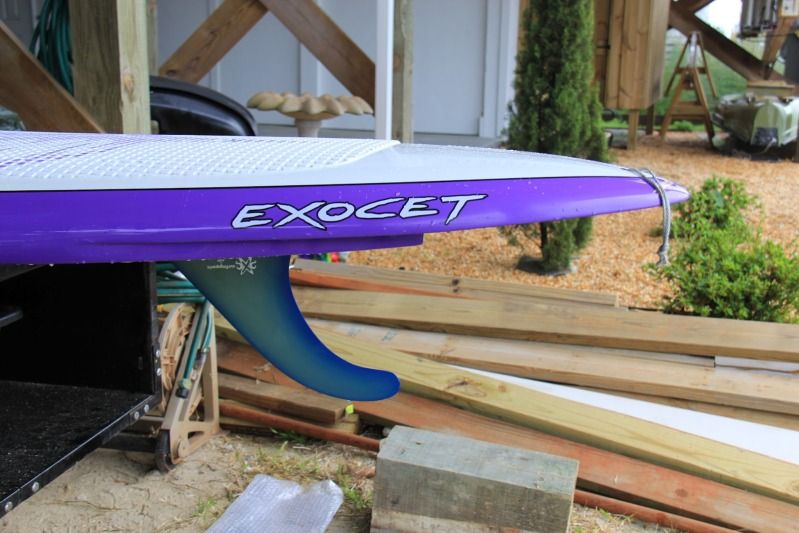
Supposedly it has improved light wind planing ability and SUP ability compared to the Kona ONE. It’s considerably larger than I would ideally want, but I’m encouraged by the mere fact that it exists, proving that it IS possible to have a fully-planing windsurfing board that SUPs well in waves. I really need to test one for myself, I mean, uh, for my fiancé.

Supposedly it has improved light wind planing ability and SUP ability compared to the Kona ONE. It’s considerably larger than I would ideally want, but I’m encouraged by the mere fact that it exists, proving that it IS possible to have a fully-planing windsurfing board that SUPs well in waves. I really need to test one for myself, I mean, uh, for my fiancé.
Conclusion:
Most SUPs and windsurfs on the market are good for their own sport but have very limited utility for the other sport. Fortunately, recent designs like Exocet’s WindSUP show that it's not impossible to have a board that SUPs well in waves AND planes well as a windsurf. Hopefully continued evolution will refine and diversify those designs, and maybe come up with some as-yet-unseen designs like a flatwater racing SUP that’s also an efficient planing and displacement windsurfer.
PS- Late breaking news- Exocet just introduced a 10’0” WindSUP for 2013! They must have read my mind.

No comments:
Post a Comment