1. The Fox special didn't get much into the basic science of what global warming is; why there is concern about increasing greenhouse gas concentrations, etc., probably because the basic science is relatively simple and compelling, and Fox's mission was not to educate but to sow confusion and doubt. So, Fox mainly gave the grandstand to climate skeptics and spin-doctors from conservative lobby groups like the Cato Institute. These "experts" nit-picked at various real and imagined errors in the mainstream science of global warming. In particular, they quote-mined the emails stolen from the University of East Anglia's Climate Research Unit (CRU) in order to imply that the scientists there (and by extension, all global warming scientists) were conspiring to fake results and supress dissent. The quote from the CRU scientists that Fox kept repeating was "hide the decline", which was taken out of context but originally had to do with interpreting past climate from tree rings.
An old-growth Douglass Fir, the author's favorite tree species.
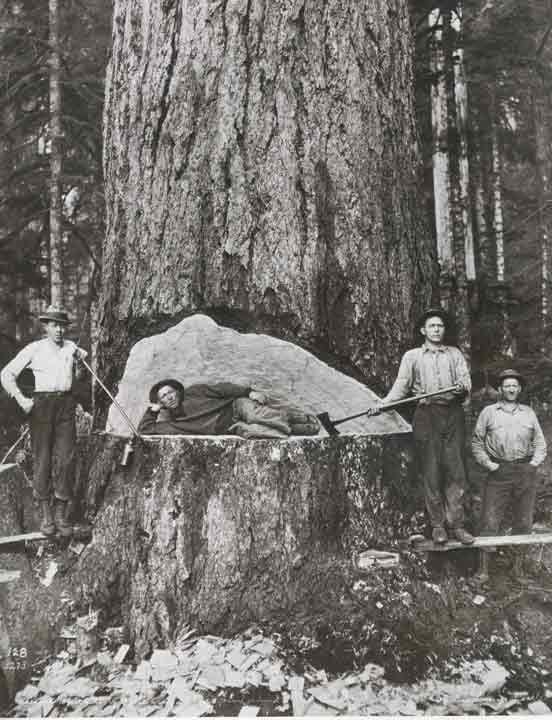
Since thermometer-based records of temperature are rare before about 100 years ago, scientists use "proxies" like tree rings and isotope ratios from ice cores to infer what the temperature was in the past. The tree ring method works pretty well, i.e. it correlates closely with the other temperature proxies and with real thermometer measurements, but only until the mid 20th century, at which point tree rings appear to show declining temperatures while all the other indicators show increasing temperatures. The reason the tree-ring vs. real-temperature correlation breaks down during this century is because increasing CO2 in the atmosphere is changing the pattern of tree growth. Trees have to open up pores on their leaves to take in CO2 for photosynthesis. When their pores are opened up they lose water, which slows their growth. But with the increased CO2 in the atmosphere they don't have to keep their pores open as long to get enough CO2, so they don't lose as much water and their growth is less affected by drought. That gives the same effect on their rings as if the temperature was decreasing. The scientist who wrote "hide the decline" was talking about how, in one particular graph from an old report, he had substituted the REAL temperature data for the tree ring data starting in 1960 where the tree ring data got screwy. That made a better representation of the real situation, but the graph wasn't properly labeled to show he had done that, which was sloppy work.
The same scientist who made the tree ring graph also had some math errors in some of his other data, which were pointed out by a global warming skeptic named Steve McIntyre. Even though McIntyre is idealogically motivated to attack the science of global warming, and often distorts the facts to that end, the problems he found in that particular scientist's data were real, and were later corrected. But after that, the CRU scientists were resentful against McIntyre, and resistant to sharing their data with him or other skeptics. They didn't want to have some skeptical papers included in one of the International Panel on Climate Change reports, and they talked about wishing they could change the definition of "peer-reviewed papers" so they could be excluded.
(Peer-review is the system for making sure that sloppy, flawed, unconvincing, overly-speculative or biased reports don't get published in official science journals. When a scientist writes a research paper and sends it to a journal, the journal editor randomly picks a small panel of "peers" to check it for quality. The peers are other scientists who are knowledgeable in the subject but unaffiliated with the writer. Sometimes mistakes get past the reviewers, or good studies get unfairly rejected, but usually it works pretty well.)
What the Fox News special didn't explain was that the CRU had no ability to actually change the peer-review system, and that the skeptical papers in question WERE accepted by reviewers and included in the IPCC report. In summary, the stolen emails showed some sloppiness and snobby behavior among the scientists, but real no conspiracy or fraud, which is more than one can say about the conservative spin doctor "think tanks" that are funded by multi-billion dollar industries to debunk global warming however they can.
Another thing that was silly about the Fox News report was how they kept referring to the results of Fox viewer polls, as if the misinformed opinions and suspicions of their conservative American audience were actually a better indication of reality than the worldwide consensus among climate scientists. One of the polls that I found particularly galling regarded the motivations of scientists. Apparently the majority of Fox viewers think scientists don't honestly believe global warming is a serious danger, but are drumming up fear and sensationalism to in a cynical effort to grab money and power for themselves. As a scientist myself, I can tell you that that is ridiculous. Scientists are definitely not out for money, at least not more than is necessary to continue studying the things that we think are interesting and important. And, while we would like it if politicians and voters would pay more attention to our scientific findings and make more rational, informed decisions, we're not out to sieze personal power.
2. The Fox special downplayed the likely consequences of global climate change. They mainly did it by not mentioning the consequences at all- consequences which include everything from loss of coral reefs, to spread of diseases, to crop failure, drought, and starvation. They even said, citing a very low-end estimate of sea level rise, that it would be "no big deal". That's a very naive and cavalier attitude to have, given that even natural ups and downs in weather and climate have had huge effects on human societies in the past, and man-made climate change is predicted to be a lot bigger and worse than those. Think of the 1930s dust bowl in the American plains, or the 19th century cities and towns on coastal islands that are now under water or eroded away. A bunch of things like that happening all over the world would definitely be "a big deal".
3. The key part of the Fox special's "don't give a hoot" message was casting aspersions on efforts to prevent climate change. They set up a false dichotomy, like, "if you want to prevent global warming you must also want to trash the economy, give up your indivdual rights and freedoms, neglect more pressing social concerns like third world health care and literacy, and basically go back to the stone ages". It's not like that, though. The whole "choose the environment or choose the economy thing is bogus" because you can't have a stable economy without a stable environment. The free "ecosystem services" that are provided by nature, like consistent rainfall, fish stocks, crop pollination by insects, waste-absorption by wetlands, erosion control by forests, etc., are a huge part of the economy that will be extremely costly, if not impossible, to replace if they get messed up by global warming and other types of environmental change.
We're a lot like the Easter Island society where the economy was based on cutting down trees for fuel and building material. Their whole economy and society collapsed when they ran out of trees and they pretty much all died off because they didn't have any alternative. The Fox special said that it would be impossible for our own society to meet all its energy needs with alternative sources other than fossil fuel, but they totally neglected to consider CONSERVATION. If we use energy less wastefully then it will be much easier for alternative energy to make up the difference.
As for the giving up rights and freedoms, it doesn't have to be so, but some kinds of regulation are necessary to avoid "the tragedy of the commons". That's like, where lots of people are sharing a resource that will get ruined if it's overused, but since it benefits each individual user to use it as much as possible before the other guys do, they will end up overusing it anyway and all being screwed in the end... Unless they can come to an enforced agreement about sharing it equitably and using it moderately.
Regarding the argument that spending money to fight global warming won't make as much improvement to the world as spending money on, like, vaccinating and feeding orphans in Rwanda, that's true. But only in the short term. Because in the long term, if we don't do something about climate change, unsustainable population growth, etc., there will be a lot more people experiencing poverty and starvation and stuff. So we need to both address current sufferring AND prevent future sufferring.
Anyway, that's about all I have for now. Feel free to leave a comment if you agree or disagree or whatever. Thanks.

No comments:
Post a Comment